Sam Levin, The Guardian; 'Bias deep inside the code': the problem with AI 'ethics' in Silicon Valley
"“Algorithms determine who gets housing loans and who doesn’t, who
goes to jail and who doesn’t, who gets to go to what school,” said
Malkia Devich Cyril, the executive director of the Center for Media
Justice. “There is a real risk and real danger to people’s lives and
people’s freedom.”
Universities and ethics boards could play a vital role in
counteracting these trends. But they rarely work with people who are
affected by the tech, said Laura Montoya, the cofounder and president of
the Latinx in AI Coalition: “It’s one thing to really observe bias and
recognize it, but it’s a completely different thing to really understand
it from a personal perspective and to have experienced it yourself
throughout your life.”
It’s
not hard to find AI ethics groups that replicate power structures and
inequality in society – and altogether exclude marginalized groups.
The Partnership on AI,
an ethics-focused industry group launched by Google, Facebook, Amazon,
IBM and Microsoft, does not appear to have black board members or staff
listed on its site, and has a board dominated by men. A separate
Microsoft research group dedicated to “fairness, accountability,
transparency, and ethics in AI” also excludes black voices."
Friday, March 29, 2019

With Vaccine Misinformation, Libraries Walk a Fine Line; Undark, March 22, 2019
Jane Roberts, Undark;
As
vanguards of intellectual freedom, public libraries face difficult questions
regarding what vaccine materials to make available. How to decide?
"The decision on what to make available to
library patrons — and what not to — would seem perilous territory for
America’s foundational repositories of ideas, though debates over library
collections are not new. Still, in an era beset by “fake news” and other
artifacts of the disinformation age, libraries (and librarians) may once again
find themselves facing difficult choices. One of the core values of librarianship, said Andrea
Jamison, a lecturer in library science at Valparaiso University in Indiana, is
upholding the principles of intellectual freedom — which include challenging
censorship. “We do want to make sure we are presenting information that is
accurate,” Jamison said. “But then the question becomes, who becomes the
determining factor?”"
Tuesday, March 19, 2019
Facebook's privacy meltdown after Cambridge Analytica is far from over; The Guardian, March 18, 2019
Siva Vaidhyanathan, The Guardian; Facebook's privacy meltdown after Cambridge Analytica is far from over
"Facebook might not be run by Bond villains. But it’s run by people who have little knowledge of or concern for democracy or the dignity of the company’s 2.3 billion users.
The privacy meltdown story should be about how one wealthy and powerful company gave our data without our permission to hundreds of companies with no transparency, oversight, or even concern about abuse. Fortunately, the story does not end with Cambridge Analytica. The United States government revealed on Wednesday that it had opened a criminal investigation into Facebook over just these practices."
"Facebook might not be run by Bond villains. But it’s run by people who have little knowledge of or concern for democracy or the dignity of the company’s 2.3 billion users.
The privacy meltdown story should be about how one wealthy and powerful company gave our data without our permission to hundreds of companies with no transparency, oversight, or even concern about abuse. Fortunately, the story does not end with Cambridge Analytica. The United States government revealed on Wednesday that it had opened a criminal investigation into Facebook over just these practices."
Myspace loses all content uploaded before 2016; The Guardian, March 18, 2019
Alex Hern, The Guardian; Myspace loses all content uploaded before 2016
Some have questioned how the embattled company, which was purchased by Time Inc in 2016, could make such a blunder."
Faulty server migration blamed for mass deletion of songs, photos and video
"Myspace, the once mighty social network, has lost every single piece of content uploaded to its site before 2016, including millions of songs, photos and videos with no other home on the internet.
"Myspace, the once mighty social network, has lost every single piece of content uploaded to its site before 2016, including millions of songs, photos and videos with no other home on the internet.
The company is blaming a faulty server migration for the mass
deletion, which appears to have happened more than a year ago, when the
first reports appeared of users unable to access older content. The
company has confirmed to online archivists that music has been lost
permanently, dashing hopes that a backup could be used to permanently
protect the collection for future generations...
Some have questioned how the embattled company, which was purchased by Time Inc in 2016, could make such a blunder."
Saturday, March 16, 2019
Department of Defense discusses the ethics of AI use at Carnegie Mellon; Pittsburgh Business Times, March 15, 2019
Julia Mericle, Pittsburgh Business Times;
Department of Defense discusses the ethics of AI use at Carnegie Mellon
"As artificial intelligence looms
closer and closer to inevitable integration into nearly every aspect of
national security, the U.S. Department of Defense tasked the Defense
Innovation Board with drafting a set of guiding principles for the
ethical use of AI in such cases.
That DIB wants to know what the public thinks.
The
DIB’s subcommittee on science and technology hosted a public listening
session Thursday at Carnegie Mellon University focused on “The Ethical
and Responsible Use of Artificial Intelligence for the Department of
Defense.”
It’s one of three DIB
listening sessions scheduled for across the U.S. to collect public
thoughts and concerns. Using the ideas collected, the DIB will put
together its guidelines in the coming months and announce a full
recommendation for the DoD later this year."
Friday, March 15, 2019
Review: 'The Inventor' is a coolly appalling portrait of Elizabeth Holmes and the Theranos scandal; The Los Angeles Times, March 14, 2019
Justin Chang, The Los Angeles Times;
"As a quick glance at this week’s headlines will remind you — a staggering college admissions scandal, a wave of indictments in the cases of Paul Manafort and Jussie Smollett — we are living in deeply fraudulent times. But if there are few people or institutions worthy of our trust anymore, perhaps we can still trust that, eventually, Alex Gibney will get around to making sense of it all. Over the course of his unflagging, indispensable career he has churned out documentaries on Scientology and Enron, Lance Armstrong and Casino Jack — individual case studies in a rich and fascinating investigation of the American hustler at work.
Review: 'The Inventor' is a coolly appalling portrait of Elizabeth Holmes and the Theranos scandal
"As a quick glance at this week’s headlines will remind you — a staggering college admissions scandal, a wave of indictments in the cases of Paul Manafort and Jussie Smollett — we are living in deeply fraudulent times. But if there are few people or institutions worthy of our trust anymore, perhaps we can still trust that, eventually, Alex Gibney will get around to making sense of it all. Over the course of his unflagging, indispensable career he has churned out documentaries on Scientology and Enron, Lance Armstrong and Casino Jack — individual case studies in a rich and fascinating investigation of the American hustler at work.
Gibney
approaches his subjects with the air of an appalled moralist and,
increasingly, a grudging connoisseur. His clean, straightforward style,
which usually combines smart talking heads, slick graphics and reams of
meticulous data, is clearly galvanized by these charismatic individuals,
who are pathological in their dishonesty and riveting in their
chutzpah. And he is equally fascinated by the reactions, ranging from
unquestioning belief to conflicted loyalty, that they foster among their
followers and associates, who in many cases shielded them, at least for
a while, from public discovery and censure.
“The
Inventor: Out for Blood in Silicon Valley,” Gibney’s latest exercise in
coolly measured outrage, is an engrossing companion piece to his other
works in this vein. The subject of this HBO documentary is Elizabeth
Holmes, the self-styled biotech visionary who dropped out of Stanford at
age 19 and founded a company called Theranos, which promised to bring
about a revolution in preventive medicine and personal healthcare. Its
top-secret weapon was a compact machine called the Edison, which could
purportedly run more than 200 individual tests from just a few drops of
blood, obtained with just a prick of the finger.
Holmes’
vision of a brave new world — one in which anyone could stop by
Walgreens and obtain a comprehensive, potentially life-saving snapshot
of their health — proved tantalizing enough to raise more than $400
million and earned her a reputation as possibly the greatest inventor
since, well, Thomas Edison. Her investors included Betsy DeVos, Rupert
Murdoch and the Waltons; Henry Kissinger, George Shultz and James Mattis
sat on her board of directors. But that was all before the Wall Street
Journal’s John Carreyrou and other investigative journalists exposed
glaring faults in the Edison’s design and sent the company’s $10-billion
valuation spiraling down to nothing. Theranos dissolved in 2018, and
Holmes and former company president Sunny Balwani were charged with
conspiracy and fraud.
Full disclosure: As the son of a retired medical technologist who spent more than 30 years testing blood the traditional way, I approached “The Inventor” with great fascination and more than a little schadenfreude. The movie, for its part, seems both magnetized and repelled by its subject, a reaction that it will likely share with its audience. Gibney is perhaps overly fond of deploying intense, lingering close-ups of Holmes’ face and peering deep into her unnerving blue eyes (“She didn’t blink,” a former employee recalls). If the eyes are the windows to the soul, “The Inventor” just keeps looking and looking, as though uncertain whether or not its subject has one."
Full disclosure: As the son of a retired medical technologist who spent more than 30 years testing blood the traditional way, I approached “The Inventor” with great fascination and more than a little schadenfreude. The movie, for its part, seems both magnetized and repelled by its subject, a reaction that it will likely share with its audience. Gibney is perhaps overly fond of deploying intense, lingering close-ups of Holmes’ face and peering deep into her unnerving blue eyes (“She didn’t blink,” a former employee recalls). If the eyes are the windows to the soul, “The Inventor” just keeps looking and looking, as though uncertain whether or not its subject has one."
I Almost Died Riding an E-Scooter Like 99 percent of users, I wasn’t wearing a helmet.; Slate, March 14, 2019
Rachel Withers, Slate;
"I’ve been rather flippant with friends about what happened because it’s the only way I know how to deal. It’s laughable that you’d get seriously injured scooting. But this isn’t particularly funny. People are always going to be idiots, yes, but idiot people are currently getting seriously injured, in ways that might have been prevented, because tech companies flippantly dumped their product all over cities, without an adequate helmet solution. Facebook’s “move fast and break things” mantra can be applied to many tech companies, but in the case of e-scooters, it might just be “move fast and break skulls.”"
I Almost Died Riding an E-Scooter
Like 99 percent of users, I wasn’t wearing a helmet.
"I’ve been rather flippant with friends about what happened because it’s the only way I know how to deal. It’s laughable that you’d get seriously injured scooting. But this isn’t particularly funny. People are always going to be idiots, yes, but idiot people are currently getting seriously injured, in ways that might have been prevented, because tech companies flippantly dumped their product all over cities, without an adequate helmet solution. Facebook’s “move fast and break things” mantra can be applied to many tech companies, but in the case of e-scooters, it might just be “move fast and break skulls.”"
Where is William H. Macy in the college admissions scandal?; The Washington Post, March 14, 2019
Monica Hesse, The Washington Post;
"The most vomitous line in the whole indictment comes from a dad — New York attorney Gordon Caplan — who tells a witness on the phone, “To be honest, I’m not worried about the moral issue.”"
Where is William H. Macy in the college admissions scandal?
"The most vomitous line in the whole indictment comes from a dad — New York attorney Gordon Caplan — who tells a witness on the phone, “To be honest, I’m not worried about the moral issue.”"
We Are! Not happy! U.S. Patent office frowns on Penn State trademark request; Pittsburgh Post-Gazette, March 14, 2019
Bill Schackner, Pittsburgh Post-Gazette; We Are! Not happy! U.S. Patent office frowns on Penn State trademark request
"Josh Gerben, a trademark attorney in Washington, D.C., offered an analysis via twitter of the geographic issue raised by the Patent Office and another reason the agency refused the application: the trademark as submitted was deemed "ornamental.''
He said both issues are correctable...
Of the ornamental issue, he said, "I believe this is trademarks 101 and it shocks me every time a large institution or organization gets it wrong.""
"Josh Gerben, a trademark attorney in Washington, D.C., offered an analysis via twitter of the geographic issue raised by the Patent Office and another reason the agency refused the application: the trademark as submitted was deemed "ornamental.''
He said both issues are correctable...
Of the ornamental issue, he said, "I believe this is trademarks 101 and it shocks me every time a large institution or organization gets it wrong.""
Thursday, March 14, 2019
One of Silicon Valley’s most prominent voices for ethical investing is implicated in a college admissions bribery scandal; Recode, March 12, 2019
, Recode; One of Silicon Valley’s most prominent voices for ethical investing is implicated in a college admissions bribery scandal
“Pretty funny,” McGlashan would later add. “The way the world works these days is unbelievable.”"
"What is particularly damaging for TPG is that McGlashan has positioned
himself as a leading voice in Silicon Valley for social responsibility...
McGlashan also allegedly made a $250,000 donation to USC
in order for his son to enter through the school’s “side door,”
according to the charges, by creating the impression that he was a
potential recruited kicker or punter for the school’s football team —
all thanks to Photoshop. This was all accomplished through mail fraud,
prosecutors say.
“I’m gonna make him a kicker/punter and they’re gonna
walk him through with football, and I’ll get a picture and figure out
how to Photoshop,” William Rick Singer, the college prep adviser at the
heart of the scandal, allegedly told McGlashan in August 2018.
“He does have really strong legs,” McGlashan told Singer. “Maybe he’ll become a kicker. You never know.”
“Pretty funny,” McGlashan would later add. “The way the world works these days is unbelievable.”"
Famed Investor Named In Elite College Scandal, Raising Critical Ethics Questions for All; Forbes, March 13, 2019
Morgan Simon, Forbes; Famed Investor Named In Elite College Scandal, Raising Critical Ethics Questions for All
McGlashan has recently gained notoriety as a proponent of impact investing. The Rise Fund, an initiative he co-founded under the TPG umbrella, has raised over $2B for interventions seeking to address global poverty and climate change.
The fact that McGlashan was a proponent of ethical investment has raised several deep questions for the sector, and for the general public. Does exercising your unchecked privilege in the world make you less ethical - separate from whether or not your actions are illegal? Should promoters of ethical investments be held to a higher standard when it comes to their personal ethics? Do you need to have impeccable ethics to be a good impact investor?...
Ethics is also about acknowledging the ways that those of us with privilege — whether it be due to social class, race, gender identity, sexual orientation, or the intersections between — can be complicit in exploiting others through fully legal means."
"Yesterday, William E. “Bill” McGlashan Jr., Founder and Managing Partner of the $13B TPG Growth fund, was indicted in the elite college scandal.
He was particularly noted for his candor in recorded phone calls about
his efforts to buy a slot at USC for his child for $250,000. The tactic,
employed by ringleader William Singer, was to photoshop McGlashan’s son to look like a recruitment-worthy football kicker — despite the fact that his son’s high school did not have a football team.
McGlashan has recently gained notoriety as a proponent of impact investing. The Rise Fund, an initiative he co-founded under the TPG umbrella, has raised over $2B for interventions seeking to address global poverty and climate change.
The fact that McGlashan was a proponent of ethical investment has raised several deep questions for the sector, and for the general public. Does exercising your unchecked privilege in the world make you less ethical - separate from whether or not your actions are illegal? Should promoters of ethical investments be held to a higher standard when it comes to their personal ethics? Do you need to have impeccable ethics to be a good impact investor?...
Ethics is also about acknowledging the ways that those of us with privilege — whether it be due to social class, race, gender identity, sexual orientation, or the intersections between — can be complicit in exploiting others through fully legal means."
Wednesday, March 13, 2019
Top Universities Join to Push ‘Public Interest Technology’; The New York Times, March 11, 2019
Natasha Singer, The New York Times;
Top Universities Join to Push ‘Public Interest Technology’
"As
technology becomes increasingly pervasive in American life,
universities across the United States have been devising ways to teach
students how to grapple with the consequences on society.
Now,
21 leading universities are banding together to promote their various
programs. On Monday, the schools announced that they had formed a new
organization called the Public Interest Technology University Network.
Members
of the group include Arizona State University, the City University of
New York, Harvard University, Howard University, the Massachusetts
Institute of Technology, Stanford University and the University of
California, Berkeley. Their goal is to train the next generation of
software engineers, policymakers, civic leaders and social justice
advocates to develop, regulate and use technology for the public good.
In other words, the group aims to both humanize technologists and technologize humanists.
“We think about two halves of the pipeline,” said Alexandra Givens, executive director
of the Institute for Technology Law and Policy at Georgetown Law
School. “One is helping technologists think about the social, ethical,
legal and policy implications of their work.”
Mark Zuckerberg And The Tech World Still Do Not Understand Ethics; Forbes, March 11, 2019
Derek Lidow, Forbes;
Mark Zuckerberg And The Tech World Still Do Not Understand Ethics
"Why the widespread blindness to the ethical and social dangers of tech startups specifically? Here are five of the principal causes:
Tech startups see themselves as saviors of the world...
Complex technology and tech business models deflect investor due diligence...
Expectations for technology startups encourage expedient, not ethical, decision making...
We’ve fetishized disruption...
Tech promises founders and investors vast—vast—amounts of money."
Colleges Build Network for Ethical Tech; Inside Higher Ed, March 12, 2019
Lindsay McKenzie, Inside Higher Ed;
"Twenty-one U.S. colleges and universities are working together to train a new generation of civic-minded technologists and tech-savvy policy makers.
The Public Interest Technology University Network, announced yesterday, is supported by the Ford Foundation, New America and the Hewlett Foundation. (Read an opinion piece by the leaders of these organizations about the new network today.)
The network will support curriculum development and faculty hiring in the nascent field of public interest technology. It will also explore how to support graduates who pursue careers in this field and create new internships and fellowships."
Colleges Build Network for Ethical Tech
"Twenty-one U.S. colleges and universities are working together to train a new generation of civic-minded technologists and tech-savvy policy makers.
The Public Interest Technology University Network, announced yesterday, is supported by the Ford Foundation, New America and the Hewlett Foundation. (Read an opinion piece by the leaders of these organizations about the new network today.)
The network will support curriculum development and faculty hiring in the nascent field of public interest technology. It will also explore how to support graduates who pursue careers in this field and create new internships and fellowships."
Thursday, March 7, 2019
Cudd preaches diversity in meeting with Staff Council; The University Times, March 4, 2019
Marty Levine, The University Times; Cudd preaches diversity in meeting with Staff Council
"Provost and Senior Vice Chancellor Ann Cudd, here just six months, told Staff Council on Feb. 20 that she “will be giving deans an incentive to widen their pools” for hiring more diverse faculty, especially African-Americans, Latinx and Native Americans.
“I’m really interested in diversity hiring,” she said in response to member questions about low levels of black students and faculty, as well as general diversity, on campuses. “If we don’t have a diverse faculty and staff here, it doesn’t feel like it’s such a welcoming place.”"
"Provost and Senior Vice Chancellor Ann Cudd, here just six months, told Staff Council on Feb. 20 that she “will be giving deans an incentive to widen their pools” for hiring more diverse faculty, especially African-Americans, Latinx and Native Americans.
“I’m really interested in diversity hiring,” she said in response to member questions about low levels of black students and faculty, as well as general diversity, on campuses. “If we don’t have a diverse faculty and staff here, it doesn’t feel like it’s such a welcoming place.”"
Wednesday, March 6, 2019
IP 101: Intellectual Property Management In The Digital Age; Forbes, March 4, 2019
Danae Vara Borrell, Forbes; IP 101: Intellectual Property Management In The Digital Age
"So, how do brands facing a high number of counterfeits leverage classic IP rights and technology to implement an effective online IP strategy and prevent brand erosion?
Many brands are streamlining processes by enforcing their IP rights, using technology-based solutions that rely on artificial intelligence (AI) and detect potential incidents on behalf of right owners. However, to be effective, the best AI-driven systems should take a holistic approach to brand protection by consolidating tools and actions on a single platform, providing full visibility on all the different types of infringements negatively impacting a company’s reputation such as black, grey and white market goods."
Saturday, March 2, 2019
Medical students wanted: Only the ethical need apply; The Boston Globe, February 28, 2019
, The Boston Globe; Medical students wanted: Only the ethical need apply
"Acceptance to medical school is notoriously difficult. You need to have an exceptional GPA and high Medical College Admission Test (MCAT) scores just to get an interview. Now, it’s getting even harder. Admissions officers have added a new kind of test to their screening arsenal, one that could change the face of medicine.
Since 2015, more than two dozen medical schools across the United States have embraced a test of interpersonal skills known as the CASPer (Computer Based Assessment for Sampling Personal Characteristics) test. The exam determines students’ levels of compassion and ethics — two qualities that many believe are critical to a physician’s success.
“As a society,” says Dore, “we know that strong academic skills aren’t the only trait we value in our doctors. We want them to be excellent communicators, have a strong moral sense, and be able to be empathetic across a variety of situations.”"
"Acceptance to medical school is notoriously difficult. You need to have an exceptional GPA and high Medical College Admission Test (MCAT) scores just to get an interview. Now, it’s getting even harder. Admissions officers have added a new kind of test to their screening arsenal, one that could change the face of medicine.
Since 2015, more than two dozen medical schools across the United States have embraced a test of interpersonal skills known as the CASPer (Computer Based Assessment for Sampling Personal Characteristics) test. The exam determines students’ levels of compassion and ethics — two qualities that many believe are critical to a physician’s success.
“As a society,” says Dore, “we know that strong academic skills aren’t the only trait we value in our doctors. We want them to be excellent communicators, have a strong moral sense, and be able to be empathetic across a variety of situations.”"
Tuesday, February 26, 2019
Startup Law A to Z: Intellectual Property; TechCrunch, February 25, 2019
Daniel McKenzie, TechCrunch; Startup Law A to Z: Intellectual Property
"Whether protected through copyright, trade secret, trademark, or patents, software technology companies depend on IP more so than perhaps any other business type in history.
It is surprising, then, just how little founders think about protecting their own IP. Sure, “product-market fit” is an all-engrossing search for truth that tolerates no distraction, but that is at best an explanation, not an excuse.
The real pros will find product-market fit while documenting and protecting IP along the way — it’s the only way to ensure you own your work, after all.
This article provides an overview to help you think about where your IP sits, how to protect it, and how to avoid certain pitfalls that plague far too many startups."
"Whether protected through copyright, trade secret, trademark, or patents, software technology companies depend on IP more so than perhaps any other business type in history.
It is surprising, then, just how little founders think about protecting their own IP. Sure, “product-market fit” is an all-engrossing search for truth that tolerates no distraction, but that is at best an explanation, not an excuse.
The real pros will find product-market fit while documenting and protecting IP along the way — it’s the only way to ensure you own your work, after all.
This article provides an overview to help you think about where your IP sits, how to protect it, and how to avoid certain pitfalls that plague far too many startups."
Thursday, February 14, 2019
Parkland school turns to experimental surveillance software that can flag students as threats; The Washington Post, February 13, 2019
Drew Harwell, The Washington Post; Parkland school turns to experimental surveillance software that can flag students as threats
"The specter of student violence is pushing school
leaders across the country to turn their campuses into surveillance
testing grounds on the hope it’ll help them detect dangerous people
they’d otherwise miss. The supporters and designers of Avigilon, the AI
service bought for $1 billion last year by tech giant Motorola
Solutions, say its security algorithms could spot risky behavior with
superhuman speed and precision, potentially preventing another attack.
But
the advanced monitoring technologies ensure that the daily lives of
American schoolchildren are subjected to close scrutiny from systems
that will automatically flag certain students as suspicious, potentially
spurring a response from security or police forces, based on the work
of algorithms that are hidden from public view.
The
camera software has no proven track record for preventing school
violence, some technology and civil liberties experts argue. And the
testing of their algorithms for bias and accuracy — how confident the
systems are in identifying possible threats — has largely been conducted
by the companies themselves."
What to tell patients when artificial intelligence is part of the care team; American Medical Association (AMA), February 13, 2019
Staff News Writer, American Medical Association (AMA); What to tell patients when artificial intelligence is part of the care team
"Artificial intelligence (AI) in health care can help manage and analyze data, make decisions and conduct conversations. The availability of AI is destined to drastically change physicians’ roles and everyday practices. It is key that physicians be able to adapt to changes in diagnostics, therapeutics and practices of maintaining patient safety and privacy. However, physicians need to be aware of ethically complex questions about implementation, uses and limitations of AI in health care.
The February issue of the AMA Journal of Ethics® (@JournalofEthics) features numerous perspectives on AI in health care and gives you an opportunity to earn CME credit."
Wednesday, February 13, 2019
The Scouts Teach Us All a Lesson About Trademark Law; Forbes, February 12, 2019
Tony Marks, Forbes; The Scouts Teach Us All a Lesson About Trademark Law
"David Harford, an attorney with Bryan Cave Leighton Paisner, contributed to this post."...
"Ultimately, the Girl Scout’s suit against the Boy Scouts demonstrates the caution that should be exercised regarding the use of intellectual property in connection with the alteration and expansion of services. This is a message that all franchisors should take to heart as they rebrand or brand products and services. The Boy Scouts likely devoted a lot of resources to determine how they should let everyone know that they were offering new services. Instead of just reaping the benefits of that work, they are now fighting a lawsuit that may result in their inability to take advantage of their new marketing strategy."
"David Harford, an attorney with Bryan Cave Leighton Paisner, contributed to this post."...
"Ultimately, the Girl Scout’s suit against the Boy Scouts demonstrates the caution that should be exercised regarding the use of intellectual property in connection with the alteration and expansion of services. This is a message that all franchisors should take to heart as they rebrand or brand products and services. The Boy Scouts likely devoted a lot of resources to determine how they should let everyone know that they were offering new services. Instead of just reaping the benefits of that work, they are now fighting a lawsuit that may result in their inability to take advantage of their new marketing strategy."
Lack of women inventors could hurt innovation, US patent office says; CNet, February 12, 2019
Erin Carson, CNet; Lack of women inventors could hurt innovation, US patent office says
The report, titled Progress and Potential: A profile of women inventors on US patents,
found that while the share of patents that include at least one woman
listed as an inventor rose from 7 percent in the 1980s to 21 percent in
2016, women accounted for only 12 percent of inventors in 2016.
"Harnessing underexploited talent in these groups would be valuable to spurring innovation and driving growth," reads the report, whose release coincided with the International Day of Women and Girls in Science. It refers to the idea of "lost Einsteins," or people who could have made valuable contributions had they been exposed to "innovation and inventor role models.""
"More women are filing patents, but they still
have a long way to go in terms of representation among inventors,
according to a report out Monday from the US Patent and Trademark
Office.
"Harnessing underexploited talent in these groups would be valuable to spurring innovation and driving growth," reads the report, whose release coincided with the International Day of Women and Girls in Science. It refers to the idea of "lost Einsteins," or people who could have made valuable contributions had they been exposed to "innovation and inventor role models.""
Monday, February 4, 2019
Let Children Get Bored Again; The New York Times, February 2, 2019
Pamela Paul, The New York Times;
Let Children Get Bored Again
Boredom teaches us that life isn’t a parade of amusements. More important, it spawns creativity and self-sufficiency.
"Kids won’t listen to long lectures, goes the argument, so it’s on us to serve up learning in easier-to-swallow portions.
But
surely teaching children to endure boredom rather than ratcheting up
the entertainment will prepare them for a more realistic future, one
that doesn’t raise false expectations of what work or life itself
actually entails. One day, even in a job they otherwise love, our kids
may have to spend an entire day answering Friday’s leftover email. They
may have to check spreadsheets. Or assist robots at a vast
internet-ready warehouse.
This sounds
boring, you might conclude. It sounds like work, and it sounds like
life. Perhaps we should get used to it again, and use it to our benefit.
Perhaps in an incessant, up-the-ante world, we could do with a little
less excitement."
Thursday, January 31, 2019
USPTO Releases 2018 Performance and Accountability Report; Guest Blog by Chief Financial Officer Tony Scardino, January 31, 2019
Director's Forum: A Blog from USPTO's Leadership
Blog homepage
| A tribute to veteran... »
Thursday Jan 31, 2019
USPTO Releases 2018 Performance and Accountability Report
"I’m pleased to announce that the USPTO has published its Performance and Accountability Report (PAR) for fiscal year (FY) 2018. The PAR serves as the USPTO’s annual report, similar to what private sector companies prepare for their shareholders. Each year the USPTO publishes this report to update the public on our performance and financial health.
Our FY 2018 PAR charts the agency’s progress toward meeting goals outlined in our 2014-2018 Strategic Plan: optimizing patent quality and timeliness; optimizing trademark quality and timeliness; and providing domestic and global leadership to improve intellectual property policy, protection, and enforcement worldwide. In addition, the PAR provides information on the USPTO’s progress towards a broader management goal: achieving organizational excellence. These goals drive the quality and quantity of our service to intellectual property stakeholders over the last five years.
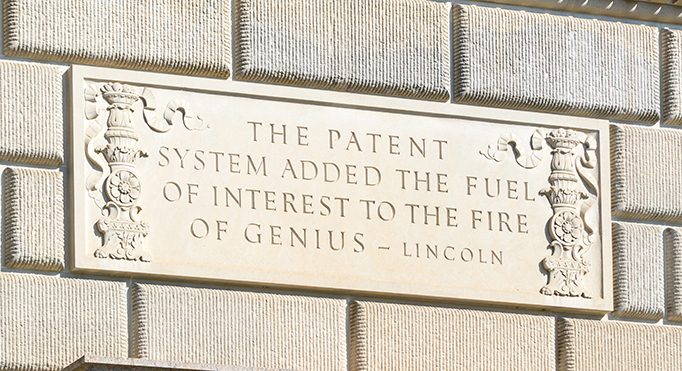
Quote by President Abraham Lincoln on the patent
system, as displayed on the Herbert C. Hoover federal building in
Washington D.C., headquarters of the U.S. Department of Commerce
Here at the USPTO, we take pride in producing a PAR that meets the highest standards of transparency, quality, and accountability. The PAR contains a wealth of data and historical information of interest to our stakeholders, including data on patent and trademark examining activities, application filings, and agency staffing levels. This information is conveniently presented in the workload tables section at the end of the PAR.
On the issue of financial performance, FY 2018 marks the 26th consecutive year that the USPTO’s financial statements have received an unmodified audit opinion. Our clean audit opinion gives the public independent assurance that the information presented in the agency’s financial statements is fairly presented and follows generally accepted accounting principles. The auditors did note a deficiency in our internal controls related to managing and configuring IT system access. We have already begun developing plans to address the auditor’s concerns. Despite this deficiency, the auditor found no material weaknesses in the USPTO’s internal controls, and no instances of non-compliance with laws and regulations affecting the financial statements.
The PAR is a faithful snapshot of the USPTO’s FY 2018 performance. I hope you find value in this document, and that it allows you to glean greater insights into the agency’s activities and achievements."
The Backlash to Larry Fink’s Letter Shows How Far Business Has to Go on Social Responsibility; Harvard Business Review (HBR), January 31, 2019
Mark R. Kramer, Harvard Business Review; The Backlash to Larry Fink’s Letter Shows How Far Business Has to Go on Social Responsibility
"Larry Fink, CEO of BlackRock, the world’s largest investor with $6 trillion under management, evoked heated controversy with his remarks last week that his company would change its hiring and potentially its compensation structure to advance diversity and ensure that five years from now the company is not just “a bunch of white men.” This follows on the heels of his annual letter to CEOs asserting that companies need to embrace a purpose beyond just profit maximization.
Critics, according to Fox Business, were swift to accuse Fink’s commitment to diversity as a form of “corporate socialism,” complaining about “the propriety of a public company executive using business resources and his perch as CEO to advance a personal agenda.” The Fox article went on to quote Charles Elson, a corporate governance expert at the University of Delaware, saying: “This is fundamentally not the role of a public company, and it’s unfair to investors who may not agree with his politics. A CEO shouldn’t use house money to further a goal that may not create economic returns.”
I couldn’t disagree more. Business leaders must finally, once and for all, let go of the outdated and erroneous notion that social factors — and not just diversity — are irrelevant to the economic success of our companies."
"Larry Fink, CEO of BlackRock, the world’s largest investor with $6 trillion under management, evoked heated controversy with his remarks last week that his company would change its hiring and potentially its compensation structure to advance diversity and ensure that five years from now the company is not just “a bunch of white men.” This follows on the heels of his annual letter to CEOs asserting that companies need to embrace a purpose beyond just profit maximization.
Critics, according to Fox Business, were swift to accuse Fink’s commitment to diversity as a form of “corporate socialism,” complaining about “the propriety of a public company executive using business resources and his perch as CEO to advance a personal agenda.” The Fox article went on to quote Charles Elson, a corporate governance expert at the University of Delaware, saying: “This is fundamentally not the role of a public company, and it’s unfair to investors who may not agree with his politics. A CEO shouldn’t use house money to further a goal that may not create economic returns.”
I couldn’t disagree more. Business leaders must finally, once and for all, let go of the outdated and erroneous notion that social factors — and not just diversity — are irrelevant to the economic success of our companies."
Subscribe to:
Posts (Atom)