Showing posts with label anger. Show all posts

Sunday, November 1, 2026

Inside a Ukrainian city hit by Russian drones during the Starlink disruption; PBS, October 30, 2026

 , , , PBS; Inside a Ukrainian city hit by Russian drones during the Starlink disruption

"In Ukraine, President Zelenskyy made the clearest indication yet that a disruption of Starlink technology contributed to civilian deaths. Elon Musk admitted last week to ordering the slowdown of the service. The intentional hindrance of Ukrainian defenses led to bipartisan anger in Washington."

Tuesday, June 9, 2026

US appeals court judge charged in parking lot scuffle faces ethics inquiry; Reuters, June 8, 2026

 , Reuters; US appeals court judge charged in parking lot scuffle faces ethics inquiry

"A judge on the largest U.S. federal appeals court is facing a judicial misconduct inquiry after news reports over the weekend revealed that he had been criminally ​charged over a parking lot dispute in Idaho in April.

Chief U.S. Circuit Judge Mary Murguia of the 9th ‌U.S. Circuit Court of Appeals in an order released on Monday said she had initiated a judicial misconduct complaint against U.S. Circuit Judge Ryan Nelson after he was hit with misdemeanor charges of battery and malicious injury to property on April 22."

Saturday, June 6, 2026

The AI vibe shift is real: Why the backlash is growing; Mashable, June 6, 2026

 Chris Taylor, Mashaable; The AI vibe shift is real: Why the backlash is growing

"But outside the AI bubble, a backlash is brewing, and not only among students booing pro-AI commencement speakers. 

Just 10 percent of Americans say they're thrilled about the future of AI, a Pew poll found in March; that same month, some 80 percent of registered U.S. voters in an NBC poll said neither Democrats nor Republicans are doing a good job on the AI front. That number also appears in an April survey of white-collar workers: 80 percent are straight-up refusing to use AI even when it's mandated. In the last 30 days, 54 percent of workers reported bypassing company AI tools and completing jobs themselves.

Those numbers suggest general strike-levels of discontent with AI across every industry, out there in the real America beyond Silicon Valley and Wall Street, if not an outright revolutionary mood. 

Data center protests, fueled by the 70 percent of Americans who say they don't want data centers near them, are only likely to grow going forward — especially now that they are producing tangible results. At least 48 data center projects were blocked or delayed in 2025, according to Data Center Watch, and the fight is only getting more fierce."

Sunday, December 28, 2025

Government Officials Once Stopped False Accusations After Violence. Now, Some Join In.; The New York Times, December 25, 2025

 , The New York Times; Government Officials Once Stopped False Accusations After Violence. Now, Some Join In.

"A churn of disinformation after a major news event is hardly a surprise anymore, but its spread after the Brown killings was not limited to the dark fringes of the internet. It was fueled by prominent figures in business and government whose false statements or politically charged innuendo compounded public anger and anxiety.

That has raised new alarms about the nature and quality of public discourse — and whether there is any consequence for those who degrade it or for the social media platforms that reward it."

Saturday, December 27, 2025

7 Questions to Ask Yourself for a Happier New Year; The New York Times, December 26, 2025

  , The New York Times; 7 Questions to Ask Yourself for a Happier New Year

"At the end of every year, I like to reflect by asking myself a question. This year, I’m mulling one recommended by Kandi Wiens, the author of “Burnout Immunity.”

Dr. Wiens told me to ask myself: What is worth remembering from 2025?...

Now it’s your turn. I asked experts for other reflective questions that could provide a framework for thinking about the year ahead. Pick one or two that resonate, journal about them or discuss them with a friend.

When did you feel the most joyful and carefree?...

What gave you energy — and what drained it?...

What seemed impossible — but you did it anyway?...

What habit, if you did it more consistently, would have a positive effect on your life?...

What did you try to control that was actually outside your control?...

Is there anyone you need to forgive in 2026?

Hanging on to anger and resentment can take mental and emotional energy, said Anthony Chambers, a psychologist and the chief academic officer of the Family Institute at Northwestern University. Deciding to forgive, he added, doesn’t mean forgetting.

Instead, it’s a “choice to stop letting a past action control our present emotions,” he said, and it can be good for your mental health. To help his patients get started, Dr. Chambers frequently recommends the book “Forgiveness Is a Choice,” by Robert Enright.

“Forgiveness allows you to move forward feeling freer and fulfilled instead of filled with bitterness,” Dr. Chambers said. “And what better way to bring in 2026 than to have a sense of freedom?”"

Thursday, November 20, 2025

‘Unforgivable’: Trump’s ‘piggy’ insult is stoking more outrage than usual; The Guardian, November 19, 2025

 , The Guardian; ‘Unforgivable’: Trump’s ‘piggy’ insult is stoking more outrage than usual

"It’s one outrage in days full of outrageous material.

“Quiet, piggy,” Donald Trump told a female reporter in a press gaggle, pointing his finger at her angrily.

It wasn’t the first time – not even the hundredth time – the US president has attacked the media. And it’s hard for any storyline to break through the administration’s “flood the zone” strategy, much less one like this. Nothing seems to stick. But the “quiet, piggy” clip has taken off, several days after the admonishment occurred on Air Force One last Friday, and without much help from the media itself.

“I don’t know why the ‘Piggy’ thing is bothering me so much,” wrote Hank Green, a YouTuber and author. “It’s one more unforgivable thing in a list of 20,000 unforgivable things, but I’ve been mad about it for like 12 straight hours.”...

Part of the collective ire could be that no one in the press gaggle jumped to Lucey’s defense in the video, underlining that those attacked by Trump often stand alone while others fear becoming next on his list; the media backbone that stiffened in his first term has wilted, under exhaustion and at the hands of Trump-friendly owners, in his second. The condemnations of Trump and accolades for both journalists came after the fact...

In Trump 2.0, you never know which affronts to decency will stick in people’s minds. This one, though, has a symbolism that seems to be resonating.

“Portland has reclaimed the frog as a symbol of its resistance to Trump’s efforts to militarize the city,” former US attorney and commentator Joyce Alene wrote on X. “Perhaps women should claim the glamorous, sassy Muppet Miss Piggy, a known diva with a fierce karate chop, as their own symbol.”"

Wednesday, March 25, 2020

That Discomfort You’re Feeling Is Grief; Harvard Business Review (HBR), March 23, 2020

Scott Berinato, Harvard Business Review (HBR); That Discomfort You’re Feeling Is Grief


"One colleague mentioned that what she felt was grief. Heads nodded in all the panes.

If we can name it, perhaps we can manage it. We turned to David Kessler for ideas on how to do that. Kessler is the world’s foremost expert on grief. He co-wrote with Elisabeth Kübler-Ross On Grief and Grieving: Finding the Meaning of Grief through the Five Stages of Loss. His new book adds another stage to the process, Finding Meaning: The Sixth Stage of Grief. Kessler also has worked for a decade in a three-hospital system in Los Angeles. He served on their biohazard’s team. His volunteer work includes being an LAPD Specialist Reserve for traumatic events as well as having served on the Red Cross’s disaster services team. He is the founder of www.grief.com which has over 5 million visits yearly from 167 countries...

What can individuals do to manage all this grief?

Understanding the stages of grief is a start. But whenever I talk about the stages of grief, I have to remind people that the stages aren’t linear and may not happen in this order. It’s not a map but it provides some scaffolding for this unknown world. There’s denial, which we say a lot of early on: This virus won’t affect us. There’s anger: You’re making me stay home and taking away my activities. There’s bargaining: Okay, if I social distance for two weeks everything will be better, right? There’s sadness: I don’t know when this will end. And finally there’s acceptance. This is happening; I have to figure out how to proceed.

Acceptance, as you might imagine, is where the power lies. We find control in acceptance. I can wash my hands. I can keep a safe distance. I can learn how to work virtually...

One particularly troubling aspect of this pandemic is the open-endedness of it. 

This is a temporary state. It helps to say it. I worked for 10 years in the hospital system. I’ve been trained for situations like this. I’ve also studied the 1918 flu pandemic. The precautions we’re taking are the right ones. History tells us that. This is survivable. We will survive. This is a time to overprotect but not overreact.

And, I believe we will find meaning in it. I’ve been honored that Elisabeth Kübler-Ross’s family has given me permission to add a sixth stage to grief: Meaning. I had talked to Elisabeth quite a bit about what came after acceptance. I did not want to stop at acceptance when I experienced some personal grief. I wanted meaning in those darkest hours. And I do believe we find light in those times. Even now people are realizing they can connect through technology. They are not as remote as they thought. They are realizing they can use their phones for long conversations. They’re appreciating walks. I believe we will continue to find meaning now and when this is over." 

Sunday, July 17, 2016

Presidents need to be able to do nothing. Donald Trump can’t do it.; Washington Post, 7/15/16

J. Peter Scoblic, Washington Post; Presidents need to be able to do nothing. Donald Trump can’t do it. :
"In crises, there is enormous pressure to act — a “plunge toward action,” as historians Richard Neustadt and Ernest May have written. Yet smart leadership demands self-control. Presidential history is replete with examples of judicious inaction...
The presidency may be a bully pulpit, but that makes it all the more imperative that its occupant knows how to keep his mouth shut and his powder dry. Trump rarely has shown such discipline — in his campaign statements or his business ventures.
During his presidential run, he has lurched from one angry outburst to the next, attacking anyone who dares criticize him, childishly belittling his opponents and excommunicating news organizations (including The Washington Post) that don’t sufficiently flatter him. He is so reflexively combative that, according to Fox News’s Howard Kurtz, his staff has stopped presenting him with interview requests to reduce the “risk of the candidate making mistakes or fanning minor controversies.”"

Monday, July 26, 2010

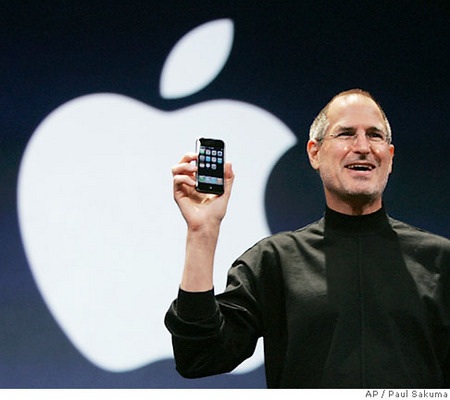
Steve Jobs's Disastrous iPhone 4 Press Conference; Harvard Business Review, 7/19/10

Nick Morgan, Harvard Business Review; Steve Jobs's Disastrous iPhone 4 Press Conference:

"I watched with growing dismay and disbelief as Steve Jobs struggled through his press conference last week about the iPhone 4 dropped calls. Jobs has a rightly earned reputation as a remarkable communicator; indeed there has been at least one book written about his presentation style as something worthy of emulation. But his usual elegant combination of enthusiasm and sang-froid deserted him at Friday's press conference. Jobs was defensive, angry, and ultimately ineffective. It's a classic example of how not to conduct public relations.

Jobs usually comes out beaming and full of enthusiasm for a new product or update. His body language reflects that enthusiasm; he's open, gestures comfortably with his hands, and makes a good connection with his audience.

Today, he was deep in his own personal maelstrom of defensiveness and hostility. His head was frequently down; in fact his whole posture betrayed his unhappiness. He frequently hid his hands behind his back — a classic defensive posture — when he wasn't clasping them in front of his stomach (another defensive posture).

He began by showing a long demo whose sole purpose seemed to be to demonstrate that other smart phones drop calls too. This is akin to defending yourself by saying, "Yeah, well, Jimmy stole cookies from the cookie jar, too!" In other words, it's no defense at all, and it looks nasty, dragging everyone else into the mire with you.

Saying, "We're not perfect; smart phones aren't perfect," repeatedly, Jobs added a kind of surly repetitiveness to his defensiveness.

Then he got into the data, which in fact shows that not many people are complaining about the iPhone 4, and it's not dropping many more calls than the 3GS. But his tone was angry and defensive, so his argument sounded petulant rather than contrite.

When a company wants to put out a PR fire, the only way to do it is to humbly acknowledge whatever mistakes happened and offer to do something concrete about it to see that it stops or it won't happen again. Jobs' attitude throughout was, as he said about 10 minutes in, that the whole thing was "blown out of proportion." That won't win back the customers whose calls were dropped, and it won't satisfy the press.

Transparency is the key for all PR blunders, but transparency without attitude. Unfortunately, Jobs had attitude oozing from every pore. So much so that when he said, "We care about every user," he sounded like he didn't mean it. Putting his hands behind his back at that precise moment didn't help either.

So pervasive was his anger that it colored the best moment in the news conference, when he announced that every iPhone 4 user was going to get a free case to solve the antenna-dropped calls problem. That should have initiated the beginning of the end of the PR fiasco, because it was the right thing to do: take action to repair the damage in a way that brings some benefit to the customer. But the way Jobs handled it sounded grudging. He said that Consumer Reports suggested Apple should "just give everyone a free case - so we are." His tone was close to a snarl.

Jobs ended on stronger ground, talking about his — and Apple's — passion for delighting their customers. Here he was on a happier plane, and he managed to sound more convincing, if still a little grumpy.

Jobs is Apple's spokesperson, and he usually does a terrific job. But in this case, his anger and his defensiveness got the better of him. Apple is now a dominant player in the consumer technology market and it can't afford this kind of ham-fisted performance. Jobs should remove himself from the lineup and let someone else take over. Or he should get over himself and cheer up. But Friday's press conference was not good corporate PR.

Nick Morgan is President of Public Words Inc, a communications consulting firm, and author of Trust Me: Four Steps to Authenticity and Charisma."

http://blogs.hbr.org/cs/2010/07/steve_jobss_disastrous_iphone.html