Showing posts with label strategic plan. Show all posts

Thursday, January 20, 2022

2022–2026 Strategic Plan: Fostering Creativity and Enriching Culture; U.S. Copyright Office, January 20, 2022

U.S. Copyright Office; 2022–2026 Strategic Plan: Fostering Creativity and Enriching Culture

"The Copyright Office has released its 2022–2026 Strategic Plan: Fostering Creativity and Enriching Culture. The plan seeks to benefit the public by expanding the Office’s outreach, improving integration of data and technology, and continuing to provide expertise to the copyright community as a whole.

For more information about the strategic plan, download or view the complete document here."

Thursday, January 31, 2019

USPTO Releases 2018 Performance and Accountability Report; Guest Blog by Chief Financial Officer Tony Scardino, January 31, 2019

Director's Forum: A Blog from USPTO's Leadership
Blog homepage | A tribute to veteran... »
Thursday Jan 31, 2019 

USPTO Releases 2018 Performance and Accountability Report 

Guest Blog by Chief Financial Officer Tony Scardino

"I’m pleased to announce that the USPTO has published its Performance and Accountability Report (PAR) for fiscal year (FY) 2018. The PAR serves as the USPTO’s annual report, similar to what private sector companies prepare for their shareholders. Each year the USPTO publishes this report to update the public on our performance and financial health.

Our FY 2018 PAR charts the agency’s progress toward meeting goals outlined in our 2014-2018 Strategic Plan: optimizing patent quality and timeliness; optimizing trademark quality and timeliness; and providing domestic and global leadership to improve intellectual property policy, protection, and enforcement worldwide. In addition, the PAR provides information on the USPTO’s progress towards a broader management goal:  achieving organizational excellence.  These goals drive the quality and quantity of our service to intellectual property stakeholders over the last five years.

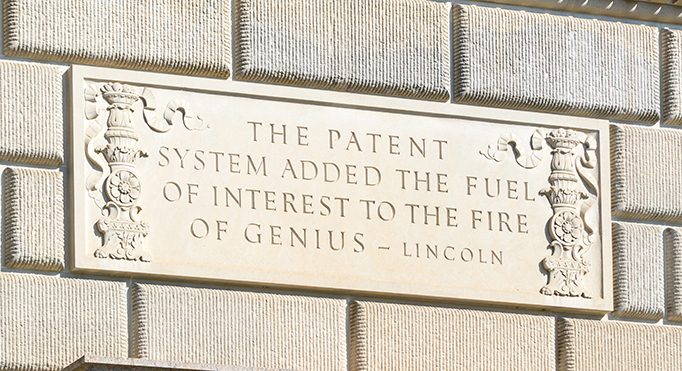
Quote by President Abraham Lincoln on the patent system
Quote by President Abraham Lincoln on the patent system, as displayed on the Herbert C. Hoover federal building in Washington D.C., headquarters of the U.S. Department of Commerce

While the PAR is a record of our achievements, it is also an honest discussion of the challenges we face as an agency moving forward under our new 2018-2022 Strategic Plan, which was published in November. We will continue efforts to issue predictable and reliable patents; continue implementation of the patent dispute resolution portions of the America Invents Act (AIA), including ensuring that procedures and standards are balanced and predictable; monitor and help address dynamic IP issues in Congress and the Courts; maintain the high and sustained trademark performance level in the face of significant trademark application growth rates; improve the customer experience and develop outreach at both headquarters and regional offices; expand on dissemination of data; maintain sustainable funding; and ensure our IT systems enable our nationwide workforce to serve our customers with a “24/7/365” operational capability.

Here at the USPTO, we take pride in producing a PAR that meets the highest standards of transparency, quality, and accountability. The PAR contains a wealth of data and historical information of interest to our stakeholders, including data on patent and trademark examining activities, application filings, and agency staffing levels. This information is conveniently presented in the workload tables section at the end of the PAR.

On the issue of financial performance, FY 2018 marks the 26th consecutive year that the USPTO’s financial statements have received an unmodified audit opinion. Our clean audit opinion gives the public independent assurance that the information presented in the agency’s financial statements is fairly presented and follows generally accepted accounting principles. The auditors did note a deficiency in our internal controls related to managing and configuring IT system access. We have already begun developing plans to address the auditor’s concerns. Despite this deficiency, the auditor found no material weaknesses in the USPTO’s internal controls, and no instances of non-compliance with laws and regulations affecting the financial statements.

The PAR is a faithful snapshot of the USPTO’s FY 2018 performance. I hope you find value in this document, and that it allows you to glean greater insights into the agency’s activities and achievements."

Wednesday, August 22, 2018

USPTO Seeking Public Comments on Draft 2018-2022 Strategic Plan; U.S. Patent and Trademark Office (USPTO), August 22, 2018

USPTO Seeking Public Comments on Draft 2018-2022 Strategic Plan

"The United States Patent and Trademark Office (USPTO) today announced it is seeking comments on the draft 2018-2022 Strategic Plan. The draft plan sets out the USPTO's mission-focused strategic goals: to optimize patent quality and timeliness; to optimize trademark quality and timeliness; and to provide domestic and global leadership to improve intellectual property (IP) policy, enforcement, and protection worldwide.
 
The USPTO welcomes comments on all aspects of the plan. Comments should be sent by email addressed to Strategicplanning1@uspto.gov (link sends e-mail). The USPTO will consider all comments received during the public comment period from August 22 through September 20, and anticipates posting the final strategic plan for FY 2018-2022 on www.uspto.gov in November 2018.
For more information on the proposed 2018-2022 Strategic Plan at the USPTO, please visit www.uspto.gov/about-us/performance-and-planning/strategy-and-reporting"

Monday, February 5, 2018

Compass Reading: IMLS’s 2018–22 Strategic Plan Sets a New Tone | Editorial; Library Journal, February 1, 2018

Rebecca T. Miller, Library Journal; Compass Reading: IMLS’s 2018–22 Strategic Plan Sets a New Tone | Editorial

"In January, IMLS released a new strategic plan, which spans 2018–22 and posits four goals. This pivotal document offers a glimpse into the institution’s priorities and approach in the near future.

Titled “Transforming Communities,” it leverages libraries and museums as trusted sources and places for engagement and dialog, with a focus on deeper inclusion, reducing barriers to access, and amplifying impact across the life span. It emphasizes cross-institutional collaboration and deepening local investment in projects though grant and award design. It also posits a new vision—“a nation where museums and libraries work together to transform the lives of individuals and communities.”

I reached out to IMLS director Kathryn K. Matthew to hear more about it. “We’ve placed much more emphasis on our vision and desired outcomes this time rather than the tactical aspects of the plan,” she says. “The vision and values of IMLS are like compass points and the plan is more of a map.”"

Tuesday, January 6, 2015

Siobhan A. Reardon: LJ’s 2015 Librarian of the Year; Library Journal, 1/6/15

John N. Berry III, Library Journal; Siobhan A. Reardon: LJ’s 2015 Librarian of the Year:
"President and Director, Free Library of Philadelphia
She engineered the creation of an ambitious, five-year strategic plan, underpinned by a powerful mission to advance literacy, guide learning, and inspire curiosity through the Free Library of Philadelphia (FLP). Siobhan A. Reardon had been in the director’s chair for less than a month when FLP was handed a 20 percent cut and branch hours were drastically reduced. Library state funding was slashed by 34 percent. In 2010, with funding trickling back into the budget, FLP launched a two-year process to formalize a new strategic plan. “We agreed that we had to stop trying to be all things to all people; we just didn’t have the money,” Reardon says.
Instead, her plan refocused the role of the library, identifying five target populations (job seekers, ­entrepreneurs, new Americans, children under five, and people with disabilities). The plan outlines a cluster model to streamline and enhance neighborhood library services, share resources and staff among neighborhood libraries, and collaborate with community leaders to develop programs and services most needed by residents."

Friday, January 24, 2014

Pennsylvania State System approves first plans for differing tuition, fees by campus; Pittsburgh Post-Gazette, 1/23/14

Bill Schackner, Pittsburgh Post-Gazette; Pennsylvania State System approves first plans for differing tuition, fees by campus:
"Efforts by Edinboro to attract out-of-staters were hampered by rules requiring it and Pennsylvania's 13 other state-owned universities to charge nonresident students thousands of dollars more to attend.
But a vote Thursday by the State System of Higher Education's board of governors to let Edinboro slash its out-of-state tuition to within a few hundred dollars of what Pennsylvanians pay could begin leveling the playing field, school president Julie Wollman said.
The experiment is already being watched by other border campuses within the State System that have faced enrollment losses since 2010, due in part to declining numbers of Pennsylvania high school graduates...
The board also approved a systemwide strategic plan setting goals through 2020, including a higher number of degrees and certificates awarded yearly, increasing working adult students and transfers and promoting more diversity and better graduation rates."

Wednesday, September 25, 2013

Books in Dumpsters Spark Debate on Future of Fairfax County, VA Libraries; Library Journal, 9/25/13

Ian Chant, Library Journal; Books in Dumpsters Spark Debate on Future of Fairfax County, VA Libraries: "Community outrage over having weeded a quarter of a million books into dumpsters isn’t the kind of public relations brouhaha that any library relishes dealing with. That scandal, though, may be the least of the problems for the Fairfax County Public Library, VA, (FCPL) where the library’s Board of Trustees has pressed pause on implementing a strategic plan that was supposed to help guide the library forward... The controversy has served to kick-start a wider-ranging conversation in Fairfax County about the future of its libraries. That conversation centers on what’s known as the Beta Project, a slate of changes to library staffing and operation that was scheduled to begin a test run in two FCPL libraries—busy Reston Regional and smaller, newly built Burke Center—this September. The most controversial item in the Beta Project would see librarian and library assistant positions scrapped in favor of a customer-service specialist position, which would not require applicants to have an MLS, MLIS, or even a bachelor’s degree. The minimum requirement for a job as a customer service specialist is an associate’s degree and at least two years of experience in retail customer service, relaxed educational requirements that have some worried. Speaking before the library Board of Trustees in June, Great Falls Library branch manager Daniela Dixon expressed some of those concerns. “The argument is made that, not to worry, the library will hire people who love books, who love providing “good customer service,” said Dixon, according to minutes from the meeting. “I am skeptical that this will be sufficient to maintain the high level of professional knowledge that librarians provide today.”"

Saturday, December 31, 2011

'Upheaval at the New York Public Library'? At the Least, Some Clouds Over Transformation Plan | News Analysis; LibraryJournal.com, 12/22/11

Norman Oder, LibraryJournal.com; 'Upheaval at the New York Public Library'? At the Least, Some Clouds Over Transformation Plan | News Analysis:

"The New York Public Library (NYPL) likes to manage its press coverage via carefully placed exclusives in the New York Times, the newspaper that matters to an institution dependent on contributions from New York's elite and the policies of top elected officials.

So it was a blow--though unclear how big--that, on November 30, The Nation published Scott Sherman's investigation, headlined "Upheaval at the New York Public Library."

His essential critique: the NYPL, while managing austerity by closing some research library spaces and tolerating branches in disrepair, is "pushing ahead with a gargantuan renovation of the Forty-second Street library, the crown jewel of the system.""